Find the constraint in an hour.
Fix it in ninety days.
I built an engine that names the one thing capping your revenue and prices it in euros. It does that without me in the room, and it gives the same answer twice. Then, if you want, I come and run the fix with you. This page is the whole method, start to finish.
Five steps. No workshops in any of them.
You answer questions about your business
Thirty-one for the free Pulse, about ten minutes. Two hundred and sixty-five for the Report, about thirty-five. No data pull, no preparation, no meeting to schedule it.
The engine names one constraint
Not a list of twenty things to improve. One structural bottleneck, with the competing explanations tested and rejected in writing. Seventy-two scoring engines, deterministic logic, no model guessing at it.
It prices what that constraint costs you
Revenue leaked per year, cost of inaction per month, recoverable value if you fix it. Numbers your CFO can check, from a model that shows its work.
You get a ninety-day plan with owners and gates
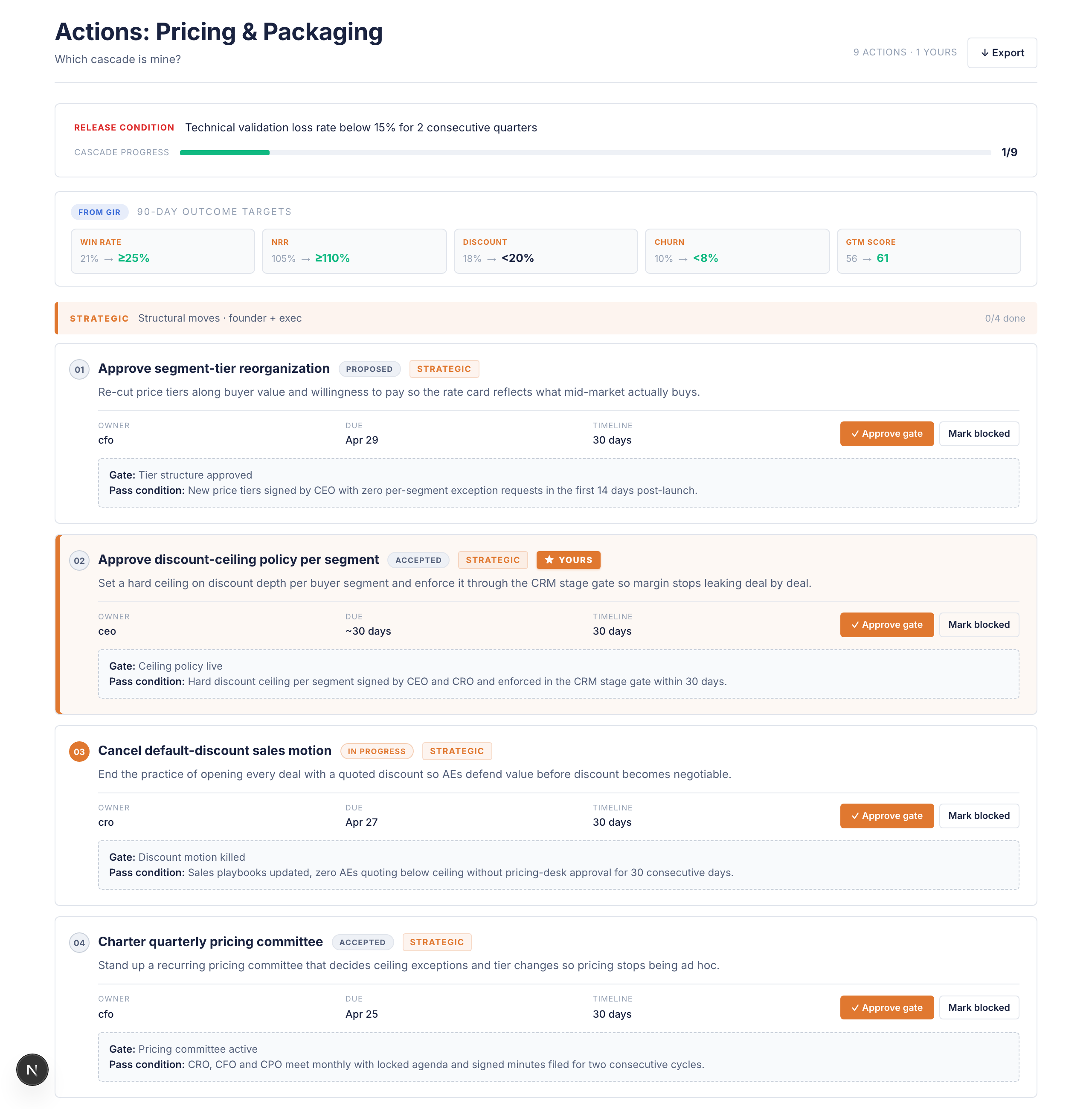
Strategic moves for the CEO, tactical for VPs, operational for the people doing the work. Each one has an owner, a deadline, a KPI, and a gate that has to clear before the next phase unlocks.
Then either you run it, or I run it with you
Plenty of teams take the plan and execute it themselves. That is a fine outcome and it costs you nothing further. If you would rather have senior hands on it, I embed one to two days a week as an operator rather than an advisor, and run the plan with your team, measured on the same live score the diagnostic produced.
One constraint. The cost of waiting. In one hour.
Your CEO and your CRO look at the same screen and agree on what to fix first. Most teams find their biggest leak is not where they thought it was.
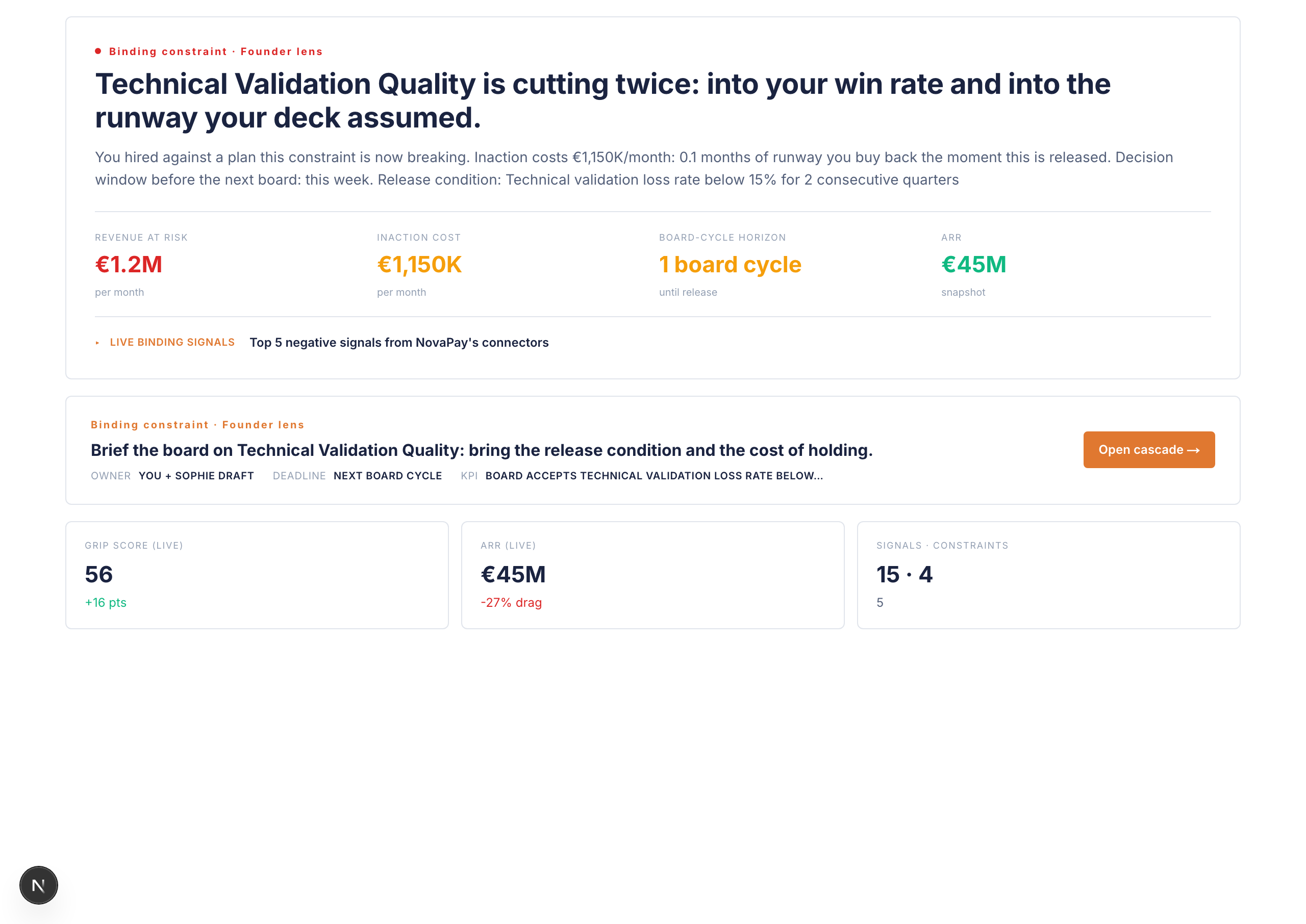
Not a slide deck. A cascade with owners and deadlines.
Boards approve strategy. Teams execute operations. The cascade is where those two meet, drawn as one connected path instead of two documents that quietly disagree.
Not opinions. Not AI guesses.
Every revenue system has exactly one binding constraint. Fix that, the whole system improves. Fix anything else, nothing changes. That is not a theory I invented, it is the Theory of Constraints, applied to go-to-market.
The engine is deterministic. Same answers in, same answer out, every time. No model-update surprise on Monday, no drift between sessions, no “the AI said something different this time”. A board review held in March and one held in June compare cleanly.
Every claim arrives tagged as fact, inference or hypothesis. Boards are not allergic to uncertainty. They are allergic to being told certainty when there is not any.
It also means I cannot lean on the engine to justify an opinion I walked in with. The output is the output. That is exactly why I trust it enough to put my own name behind the work that follows.
The rest of the system, briefly.
None of this is sold separately and none of it is the point. It is the machinery that keeps the diagnosis current while the work is running.
An advisor that answers from your data rather than from generic advice, in English and French. Four modes, including one whose job is to argue against your plan.
HubSpot, Salesforce, Gong, G2, Amplitude, Stripe and more feed the score automatically. No CSV uploads, no re-platforming, your data stays where it is.
One page every Monday: constraint status, financial impact, action progress. Forward it to your board and the monthly narrative is done.
Ask your constraint, your leak and your next move from inside Claude, ChatGPT or any MCP client. Read-only and tenant-isolated. How that works →
Buyers ask AI before they ask you. Your visibility is tracked every week across six engines, ChatGPT, Claude, Gemini, Perplexity, Grok and Mistral, with competitor share of voice and the citation gaps behind it.
Assess any company’s go-to-market from the outside, with no cooperation from them. AI visibility, review analysis, competitive position and market whitespace, in four to six minutes. Investors run it on targets; founders run it on themselves before a raise. See a sample →
If you want an operator, it is me.
Tom Meijer. A decade building GTM systems in B2B SaaS: Contentsquare from startup to a $5.6B valuation, then Greenly’s AI-first GTM and revenue architecture. I embed one to two days a week and work the ninety-day plan with your team, on the same live score, so progress is a number rather than a feeling.
Every engagement starts with the Report, and its fee comes off the first invoice. Two slots, deliberately.
Start with the free one.
It costs you ten minutes.
No signup, no card. You get your binding constraint and what it leaks per year. If that lands, we talk about the rest.